The rug looks good in the bedroom. It covers the carpet you weren’t particularly fond of, makes the space feel a little more finished, and sits just where you wanted it beside the bed. There’s just one problem: it won’t stay flat.
You straighten the fold, get on with your day, and eventually notice the same little ridge forming again. Maybe you’ve already tried a non-slip backing or tucked part of the rug beneath the bed, thinking the extra grip or weight would take care of it. It’s tempting to buy something stronger and hope that’s the end of it. But when an area rug keeps bunching on wall-to-wall carpet, the useful first question isn’t always what will hold it down? It’s what’s actually moving?
First, Figure Out What’s Actually Moving : Rug Bunching on Carpet
Two rugs can look equally wrinkled and be doing two different things. One might be slowly creeping across the carpet, shifting a little farther in the same direction as people walk over it. Another might stay more or less where you placed it while a section near the bed folds into a ridge. Unlike wood or tile, carpet has fibers that compress underfoot. If one part of the rug stays anchored beneath furniture while another part moves, the fabric can gather instead of sliding neatly as one piece.
Before reaching for another fix, straighten the rug and take a photo showing its edges against something fixed, like the bed frame or doorway. The next time you notice movement during ordinary use, compare the same spots. If the whole rug has crept away from its original position, check how the rug, any existing pad, and the carpet are gripping one another. If the edges haven’t moved much but a fold keeps returning beside the bed, look more closely at how the furniture holds one section while the exposed part shifts.
There’s another detail worth noticing: was the ridge there when the rug was first laid down, or does it develop after people walk through the room? If the crease was there from the beginning, check the rug maker’s guidance for flattening it before treating the problem as a lack of grip. A fold that develops with movement calls for a different look at the setup.
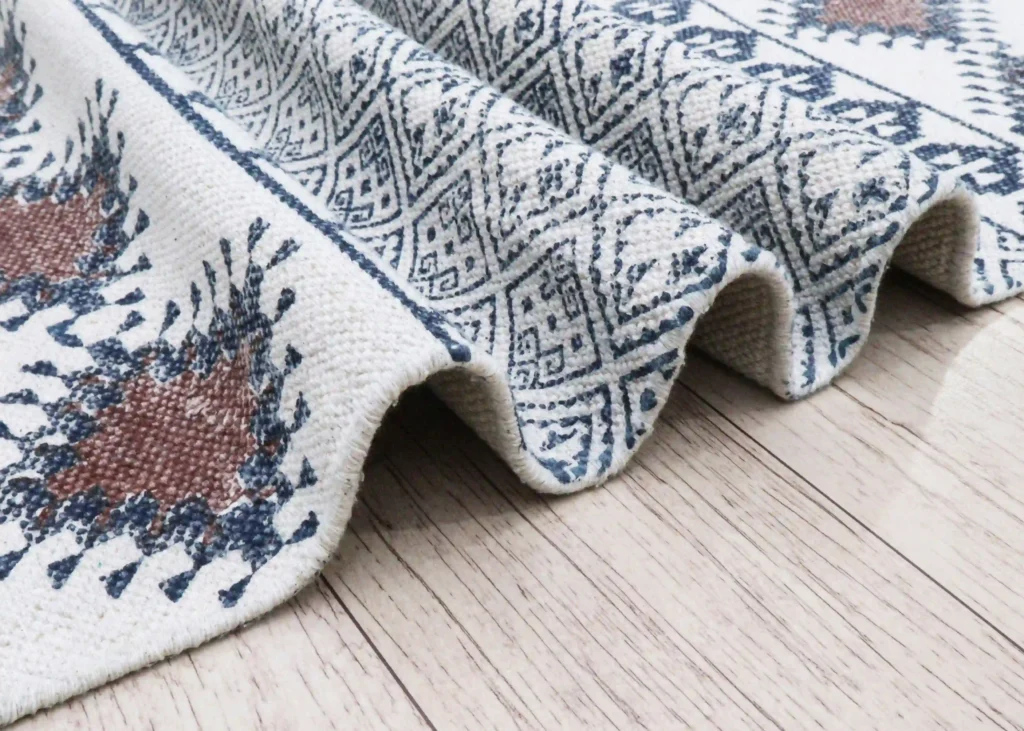
If you’re already using a pad, check whether the rug has moved across it or whether the pad has shifted along with the rug. You don’t need to turn this into a complicated experiment. Just inspect the setup when it’s safe to do so, without leaving a raised fold in someone’s walking path. It’s also worth remembering what you’ve already tried: a rubberized backing, a mesh gripper meant for hard floors, carpet tape, and a pad designed specifically for carpet aren’t interchangeable.
Why the Fixes You’ve Tried Might Not Be Helping
A rubberized backing sounds reassuring. It may provide grip, but it can’t necessarily keep a flexible rug from folding when different parts are moving in different ways. Heavy furniture has a similar limitation. A bed can hold one section of the rug firmly in place while the exposed section gradually gathers. Adding more weight isn’t always going to help that loose area.
The carpet itself makes a difference, too. A dense, low-pile carpet offers a different surface from thick, plush carpeting that gives noticeably underfoot. The rug’s backing and flexibility affect how those surfaces behave together. If you’ve already bought something labeled non-slip, take another look at what it was actually designed for. Some rug grippers are intended for hard floors, such as hardwood or tile, and aren’t suitable for an area rug over wall-to-wall carpet.
Tape is another tempting shortcut, especially when the rug seems to move only at the edges. But on carpet, adhesive compatibility and removal matter. It’s a poor trade if the rug stays put for a while but the installed flooring gets damaged when the tape comes off. Before writing off every rug pad as useless, find the model you’ve already tried and check its instructions. You might discover that it wasn’t designed for this setup in the first place.
What to Try Before Buying Another Rug Pad
Start with the carpet underneath. Lift the area rug where you can safely do so and check whether the wall-to-wall carpet is flat. If you see ripples, loose edges, or buckling in the installed carpet itself, stop looking for a stronger rug pad. That underlying issue needs attention first, potentially from a landlord or carpet professional.
If the carpet is sound, look at the rug and anything already beneath it. Maybe the pad has slipped out of position, extends beyond the rug, or isn’t installed according to its instructions. Correcting an existing pad’s position or fit may be more sensible than buying another one. Follow that particular product’s sizing guidance rather than applying a universal trimming rule. And if the rug has a stubborn curled edge or damaged backing, check the rug manufacturer’s care instructions before assuming more grip will straighten it.
Then consider the furniture arrangement. If the same fold keeps appearing beside the bed, is there a little room to reposition the rug so the exposed section isn’t gathering in the usual walking path? Sometimes the room simply won’t allow it, especially with a large bed. There’s no reason to move heavy furniture unsafely or make the layout less practical just to accommodate the rug.
For a rental, I’d be particularly careful about adding adhesive products without checking the material restrictions and lease. A quick fix isn’t much of a bargain if it creates another problem when you move out. And if a raised edge could catch someone’s foot, remove the rug from that spot until you have a safe arrangement. That’s one problem worth dealing with immediately.
So when does buying another pad actually make sense? When the installed carpet is stable, the rug itself lies reasonably flat, and the remaining issue appears to be movement between the surfaces. That’s a much better reason to consider extra grip than simply being tired of straightening the same fold.
When a Carpet-Specific Rug Pad Is Worth Considering
If you’ve reached that point, look for a pad explicitly intended for area rugs over carpet, not just something advertised as having an exceptionally strong grip. A carpet-specific pad needs to work with the rug backing and the pile underneath it. Thickness matters as well, particularly around doors or furniture. If the rug already feels cushioned enough, a low-profile gripper may make more sense than adding another thick layer.
There is some independent testing to help with that decision. In Better Homes & Gardens’ rug-pad testing, the Magic Stop carpet-on-carpet pad helped keep the test rug in place, including during vacuuming. The testers also raised concerns about how well its thin material might hold up over time.
One option to examine on Amazon US is the Slip-Stop Magic Stop rug pad, which is linked from that testing guide. This low-profile pad uses a dry, pressure-sensitive adhesive coating on a textile backing to grip the rug and carpet. It’s different from ordinary rubber mesh and doesn’t add much cushioning. Before ordering, select the size that fits your rug rather than assuming the product page opens on the dimensions you need.
The installation and removal instructions deserve a read, especially with delicate rugs or rental carpeting. Manufacturer claims about grip or residue don’t replace checking compatibility with your particular materials. And if the underlying carpet is buckled or the rug is folding around an awkward furniture arrangement, address that issue rather than expecting another pad to do all the work.
The goal was never to collect rug grippers. It was to have a room that feels comfortable and looks the way you wanted without constantly stopping to straighten the floor. Sometimes a suitable pad helps. Sometimes the answer is a small adjustment or a flooring problem that needs attention. Either way, understanding what’s happening beneath the rug is a better place to start than buying another fix and crossing your fingers.