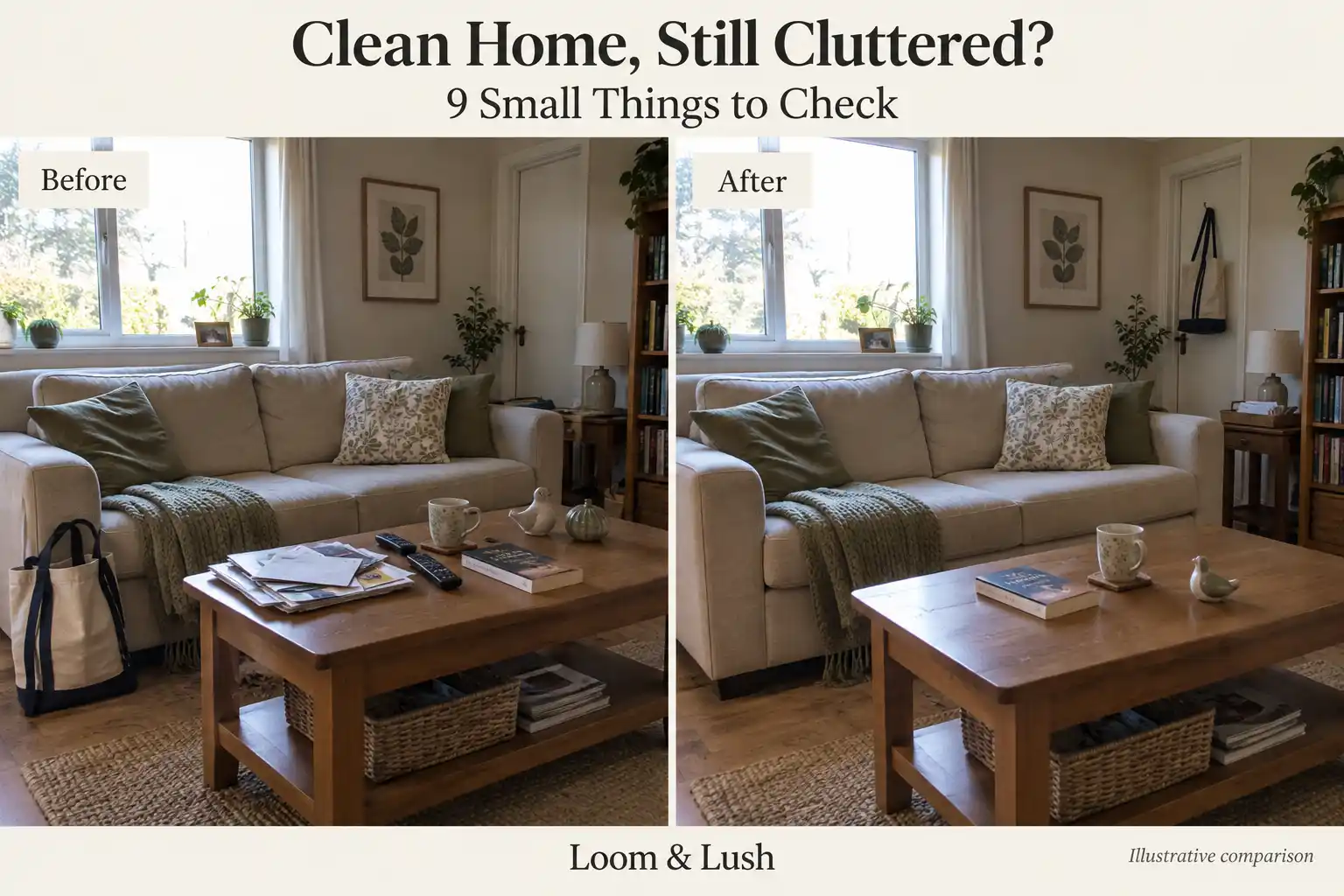
You finish cleaning the kitchen, straighten the living room, put away the laundry that’s been sitting around all day, and the house still doesn’t look quite done. Nothing is especially messy. The floor is clear. The dishes are away. Even the mail is in a neat pile instead of spread across the counter. But there are little things everywhere, now this all together they make the room look busier than it actually is.
It’s easy to assume you need to declutter more. Sometimes you do. Other times, the stuff that’s bothering you isn’t really excess at all. It’s the parcel waiting to be returned, the jeans you’ll wear again tomorrow, the charger that doesn’t have a convenient place, or a shelf that’s simply showing too many things at once. Before getting rid of anything, look at what’s left after you clean. That’s usually where the useful clues are.
Why a Clean Home Can Still Look Cluttered
There are a few different problems that tend to get called clutter.
Sometimes there is genuinely too much for the space. A drawer won’t close properly or a cupboard has to be rearranged every time you need something from the back. Then there are useful things with no real home: keys that live on whichever counter is closest, a bag that moves from chair to chair, the charger everyone uses but nobody knows where to return. Some things are simply waiting for their next step. Returns, donations, paperwork, clean laundry, clothes you’ll wear once more. They aren’t meant to stay where they are, but nothing has moved them forward yet. And sometimes the room works perfectly well. There’s just a lot to look at.
Those situations don’t need the same solution, which is why another round of “put everything away” often doesn’t change much.
Take One Photo Before You Start
Take a photo of the room in your phone before moving anything. The delivery box you’ve walked past for a week may suddenly look enormous in the picture. You might notice that the coffee table is actually fine except for one crowded end, or that it’s the cables below the TV not the furniture that are making that whole wall look busy.
Pick the first two or three spots you notice. Leave the rest alone for now. and the real work starts now
1. The Counter Is Doing Too Many Jobs
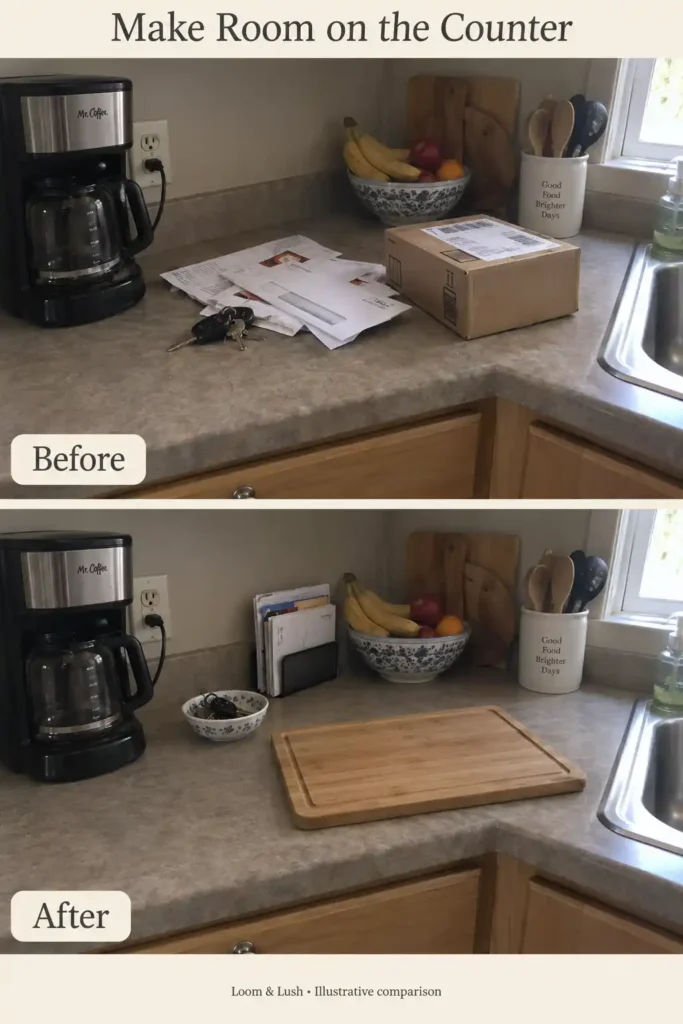
The coffee maker belongs on the kitchen counter. And the fruit bowl, if that’s where you use it. The trouble is usually starts with everything that arrives afterward. Mail gets put beside the kettle because you’ll remember to open it there. A school form needs a signature, so that stays visible too. Someone drops their keys on there. A package arrives. Vitamins migrate over from a cupboard because they’re easier to remember at breakfast. So, None of those decisions is ridiculous. That’s exactly why the counter fills up again so quickly after you clear it.
Try putting down a chopping board or a mug. If you have to move a pile first, look at what’s in the way rather than sweeping all of it into a drawer. A paper that needs signing needs a next step. Keys need somewhere easy to return on one place. Packaging may be finished with its job. Something used every morning might deserve to stay exactly where it is.
Current paperwork is a good example. Hiding it can backfire if seeing it is how you remember it. One small, visible place for papers that actually need action can work better than mixing them with old mail and manuals. Once something is signed, paid or dealt with, it leaves that spot. Otherwise you’ve just made a more organized pile.
2. Some Things Stay Out Because Putting Them Away Is Annoying
Try putting away the thing that always seems to be left out. If returning the hair dryer means moving towels, lifting a box and wrapping the cord perfectly before the cupboard closes, there’s a reason it keeps ending up on the bathroom counter.
The same thing happens with pans stacked underneath rarely used cookware, chargers assigned to another room, or daily toiletries stored behind backup supplies. now solution is Give frequently used things the easiest spaces. Let occasional items take the less convenient ones.
You don’t need the cleverest storage arrangement here. You need one that still makes sense when you’re in a hurry.
3. That Chair Is Probably Holding More Than “Laundry”
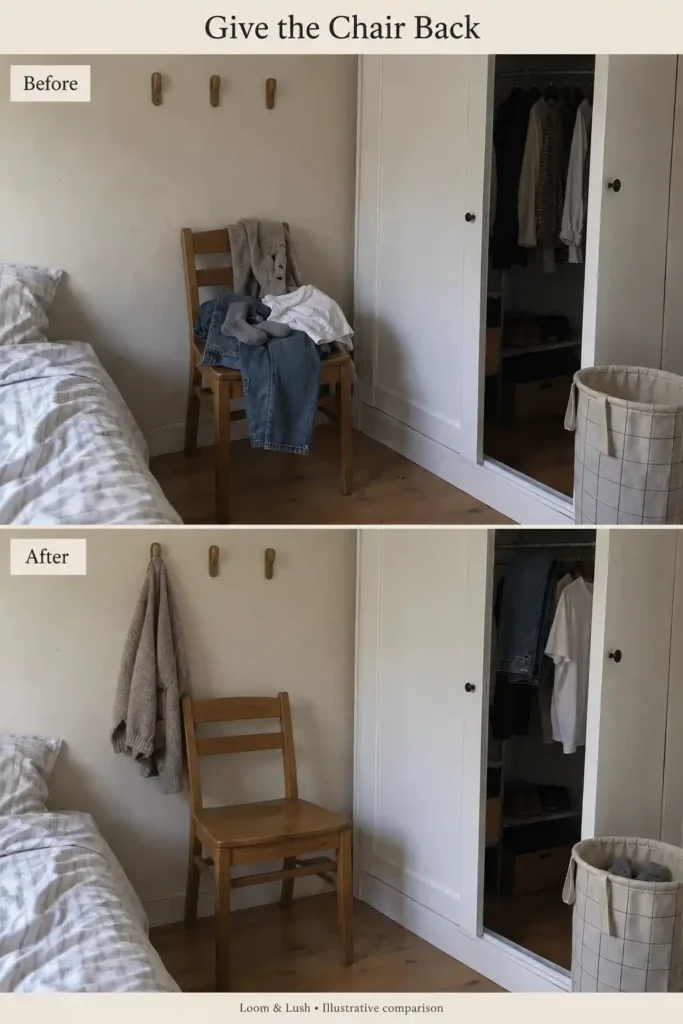
Monday’s jeans go on the chair because they’re fine for another wear. Tuesday there’s a cardigan. Then a clean T-shirt gets dropped there instead of making it into the drawer. By the end of the week something that really is dirty has joined the pile, and now dealing with the chair means sorting everything. Moving it all to the bed works until bedtime. Then it goes back.
Before buying another hamper, now separate what’s actually on the chair. that has Dirty clothes already have a destination. Clean clothes should have one too, although an overstuffed drawer may be the reason they’re not getting there.
The awkward category is usually the clothes that have been worn but aren’t ready to wash. Give those a small, separate place—a section of rail, part of a shelf, or a suitable hook you already have. Keep it limited. If ten more outfits can pile into the new spot, you’ve mostly moved the chair onto the wall.
Repair clothes need something different again. “Sew button back on” is a real next step. “Leave cardigan on chair until future me becomes interested in buttons” tends to last longer.
This isn’t only a clothing problem. Returns, donation bags and paperwork are normally unfinished tasks but all become permanent-looking clutter.
4. The Shelf Filled Up Slowly
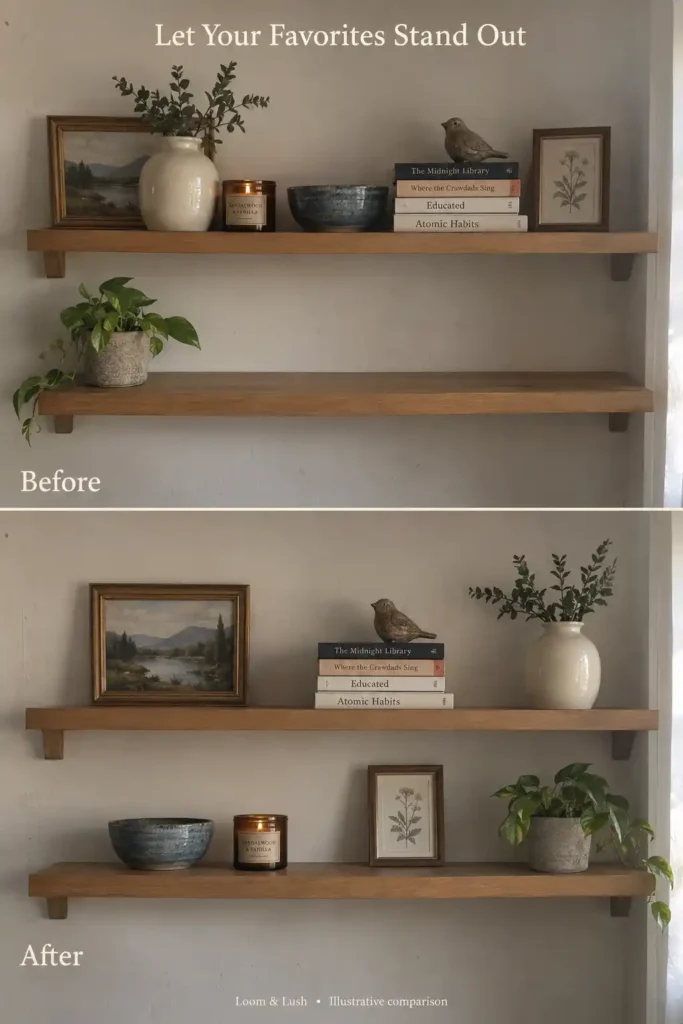
A new photograph gets added beside the old one. A candle fits in the corner. Someone gives you a little vase, so of course you find room for it. Seasonal decor arrives without much of the everyday decor leaving. then Six months later, nothing on the shelf is particularly large, but your favorite photograph is disappearing in the middle of everything else.
Don’t start by deciding what you have to get rid of. Move a few pieces temporarily and give the things you care about enough room to actually be noticed. If you miss something, bring it back. If you love a full, colorful shelf, keep one. Sentimental belongings don’t become clutter just because minimal rooms photograph well. Sometimes displaying fewer pieces at once actually lets you enjoy the ones that are there.
5. Your Open Shelf Has a Real Job
A kitchen shelf in a styled photo might hold three bowls, two mugs and a plant. Your shelf has lunch containers, tea, six mugs, water bottles and the blender attachment that doesn’t fit in the drawer. That’s not a bad styling. Your shelf is working.
Start there. Can you grab a mug and put it back without moving anything else? Can the lunch containers come down without dismantling a stack? Are the things you use once a month sitting in front of things you need every morning? then Move the frequently used items into the easiest positions and group the small loose things that belong together. Anything that doesn’t benefit from being visible can go into closed storage if you already have room for it.
If you don’t, don’t pretend you do. Useful open storage is still useful.
For kitchens where the bigger issue really is limited cupboard and counter space, these small kitchen organization ideas cover ways to work with the storage you already have.
6. Look at the Cords You Stopped Seeing
Trace the cables around the TV, desk or bedside table before trying to hide them. There may be two permanent cords, one charger that keeps travelling between rooms and another cable nobody has used in months.
Fixed devices can have fixed cable routes. Things that move need a sensible place to charge. Check unidentified cables before deciding whether they still need storage. That’s enough. You don’t need to make every wire invisible.
Keep safety ahead of appearance too—don’t cover adapters, block ventilation or route electrical cords unsafely just to get a cleaner-looking corner.
7. A Box Can Be Clutter Without Anything Being Wrong With What’s Inside
A delivery arrives and you keep the box in case the item needs returning. that’s Sensible. but A week later the item is fine, but the box is still beside the dresser. There’s another shopping bag behind it and an empty outer carton from something in the bathroom.
Packaging is easy to overlook because it feels temporary. Temporary things can still hang around for a very long time when nobody decides when “temporary” ends. Keep packaging when it’s actually needed for return requirements, useful instructions or other practical reasons. Once it has no job left, deal with it appropriately rather than letting it become part of the room. There’s no need to pour every product into a matching container either. If the original bottle is useful and has information you need, then leave it alone.
8. The Entryway Is Full of Things Going Somewhere
The donation bag beside the door is a good example. You’ve already sorted it and decided what you’re giving away. Yet you’ve stepped around the bag for ten days. in there The decluttering part is finished but The errand isn’t.
Maybe you need to check where to take it. A return needs a label. Library books need to leave on the next trip. Whatever the missing step is, figuring that out is more useful than repeatedly moving the bag so you can vacuum.
Then now look at what’s coming the other direction. there is a Keys, shoes, bags and mail naturally land somewhere when people walk in carrying things. Watch where they already go before deciding where they “should” go. If the keys land on the same console every evening, putting their home near that console is probably easier than trying to train everybody to walk across the house first.
Shared homes need shared reality too. One tiny bowl may work for one person’s keys. It won’t necessarily handle two sets of keys, school papers, work bags and everyone’s daily shoes.
9. The Organizer May Not Be the Problem—or the Solution
There’s something satisfying about putting a new divider into a chaotic drawer. Suddenly the pens are lined up. Batteries have their own compartment. Tape has a little square. The mystery keys, old receipts, screwdriver and random cables are still there too. They just look more official now.
Before replacing the organizer, take one small area and work out what actually belongs there. if there any things just return to there place. Look at duplicates. Check the things you’re unsure about instead of throwing them away just to finish quickly. Put the useful items back according to how often you reach for them.
Only then can you tell whether storage is missing. If you genuinely need something new, measure the drawer and the things going inside it. Leave enough room to get your hand in and take things back out. Technically fitting isn’t the same things as being easy to use.
Sometimes the Room Really Is Short on Storage
There isn’t a hidden organizing trick for every home.
When three people share a small bathroom, there is never enough cupboard space. The bedroom might also double as an office. In a rental home, you might only get a single small closet with no extra space to put another cabinet.
In this situation, keep the things you use the most in the best storage spots. Store the items you rarely use further away. Look for duplicate items you do not need or things you no longer use. If your useful belongings still do not fit comfortably, buying extra storage is a sensible choice if your space and budget allow it
Since you do not already own an organizer, it is okay to buy a new one. The most important thing is to know exactly what problem it will solve. Think carefully about whether you truly need it and how it will help you before you make the purchase.
Your Home Doesn’t Need to Look Unused
A book you are reading on the sofa is not a problem. Neither is the mug you are drinking from. Toys being out while kids are playing, or a laptop on the table during work hours, are not problems either. These are items that are actively in use.
Instead, look for things that are finished but still lying around: return parcels, half-worn clothes, paperwork waiting for a decision, and chargers without a proper home.
If you can easily put an item away when you are done using it, your system works well. But if that same item just moves from one temporary spot to another, you need to take a closer look. A lived-in home and a cluttered home are not the same thing
A Quick Room Check
| Room | Look here first |
|---|---|
| Kitchen | Counters, current paperwork, packaging and awkward appliance storage |
| Living room | Coffee table, cords, small decor and open shelves |
| Bedroom | The chair, nightstand, re-wear clothes and unfinished laundry |
| Bathroom | Daily products that are difficult to put away and crowded vanity space |
| Entryway | Shoes, bags, keys, mail and anything waiting to leave |
Start With Three Spots, Not the Whole House
Go back to the first photo you took and pick three places that still look messy or bother you. In one spot, you might really need to remove extra items. In another, your useful things might just need an easy home. In the third spot, a few small items might just be competing for your attention all at once. Fix just those three spots and then stop.
Live with those changes for a few days. If the same pile comes back, notice what returned and why. The new spot might be inconvenient. Maybe the item needs to stay visible. Or maybe it is waiting for someone to take action on it.
This information is much more useful than clearing the same pile five times.
If you later feel like refreshing more than just one room, our realistic September reset uses an approach that works on your home, wardrobe, and everyday routine using only what you already own.
Frequently Asked Questions
Why does my house still look cluttered after I clean?
Cleaning removes dirt and obvious mess, but it doesn’t fix everything that has no convenient home, is waiting for a decision, or is making a surface visually crowded. Look at what remains after cleaning and, especially, what keeps returning to the same place.
How do I make my home look less cluttered without becoming a minimalist?
Keep the books, color, photographs and decor you actually enjoy. Focus first on overloaded working surfaces, unfinished piles, awkward storage and things that never seem to get put back. If a room is functional but still looks busy, change one small visual area at a time instead of stripping everything out.
Should I buy more storage?
Sometimes. First work out what needs storing and whether it belongs in that space. If the useful items still don’t fit or are difficult to reach after you’ve rearranged what you already have, you’ll know what kind of storage problem you’re trying to solve.
See What Comes Back
The most useful part may happen a few days after you finish.
If the counter fills again, don’t clear it immediately. Look at what came back. The mail may need somewhere visible because otherwise you forget it. The charger may have been assigned a home nobody actually uses. The clothes on the chair may all be things you’re planning to wear again.
Now you have something specific to fix.
And if your coffee maker stays on the counter, the bookshelf remains full, or there’s a blanket on the sofa because someone uses it every night, that’s fine. A home doesn’t have to look empty to feel under control.
The goal isn’t a home that never gets messy. It’s one that’s easy to bring back.
Some images in this post may be AI-generated or AI-assisted illustrations and are intended to represent the general ideas discussed rather than our own home or belongings.
Written for LoomAndLush — practical home, style and lifestyle ideas for everyday living.