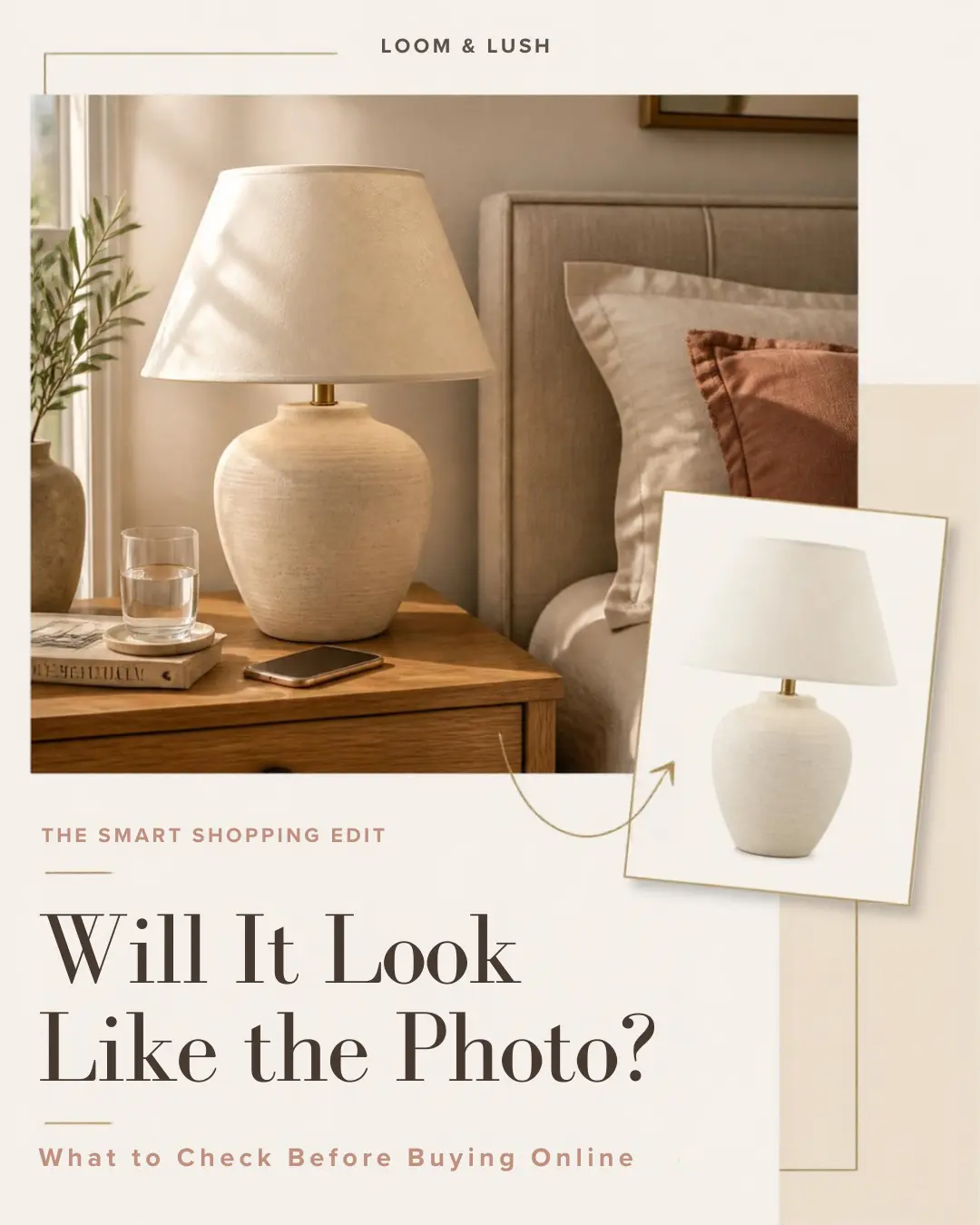
You can spend ten minutes looking at a bedside lamp and start picturing it in your bedroom without even noticing you’ve done it. The lamp looks lovely beside a neatly made bed, with warm light and just enough on the table to make the room feel lived in.
Then there’s your own bedside table. The phone charger, a water glass, a hair clip, and that book you’ve been halfway through for weeks. You still want the lamp. You just haven’t thought about where all those things will go once it’s there.
I think that’s why some online purchases are disappointing even when the product is exactly as described. The photo makes it easy to picture someone else’s lovely room, even though we’re only ordering one part of it.
Table of Contents : online product photos
See how much space it would really take
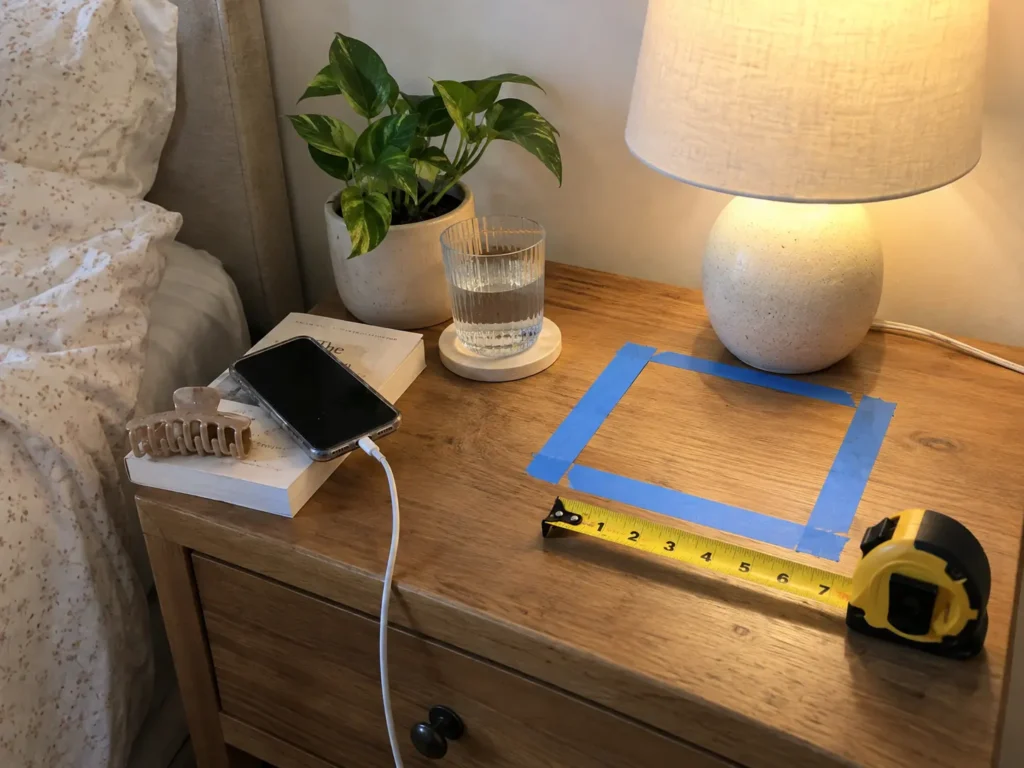
If the lamp is 11 inches tall, hold a tape measure upright on your bedside table. Have a look from the doorway or where you usually sit in bed. Eleven inches sounds perfectly reasonable until you see where it actually ends.
And I’d check the base, too. A seven-inch base might fit on the table, but will you still have enough room to reach for your water without knocking something over? Mark it out with paper or painter’s tape and leave your usual things around it. The shade could be wider than the base, so it’s worth checking that measurement as well, especially if the lamp will sit close to a wall.
Mirrors are worth doing this with, too. Mark the width and height on your wall, then step back and see how much space it takes up above your dresser. It’s surprising how a mirror that looks huge in a photo can seem quite small on a wide wall.
And if you’re looking at storage baskets, remember that fitting the shelf is only half the problem. A basket might look like the perfect size, then turn out to be too narrow at the bottom for the things you actually wanted to put in it.
That dress might feel different once it’s on you
Dresses are a little trickier. You like where the hem ends on the model, the way the waist sits, how soft the fabric looks. You’ve probably already started thinking about shoes you own that would go with it. Maybe a jacket, too. The outfit is practically put together in your head.
But the model’s height isn’t yours, and the dress isn’t necessarily going to hang the same way.
Before ordering, I’d take out a similar dress I already like and lay it flat. Say yours is 47 inches long and the new one is 43. That’s four inches of difference, which is worth knowing if you love where your current dress falls. Just make sure both lengths are measured from the same starting point and that you’re comparing garment measurements. Body measurements on a size chart are a different thing.
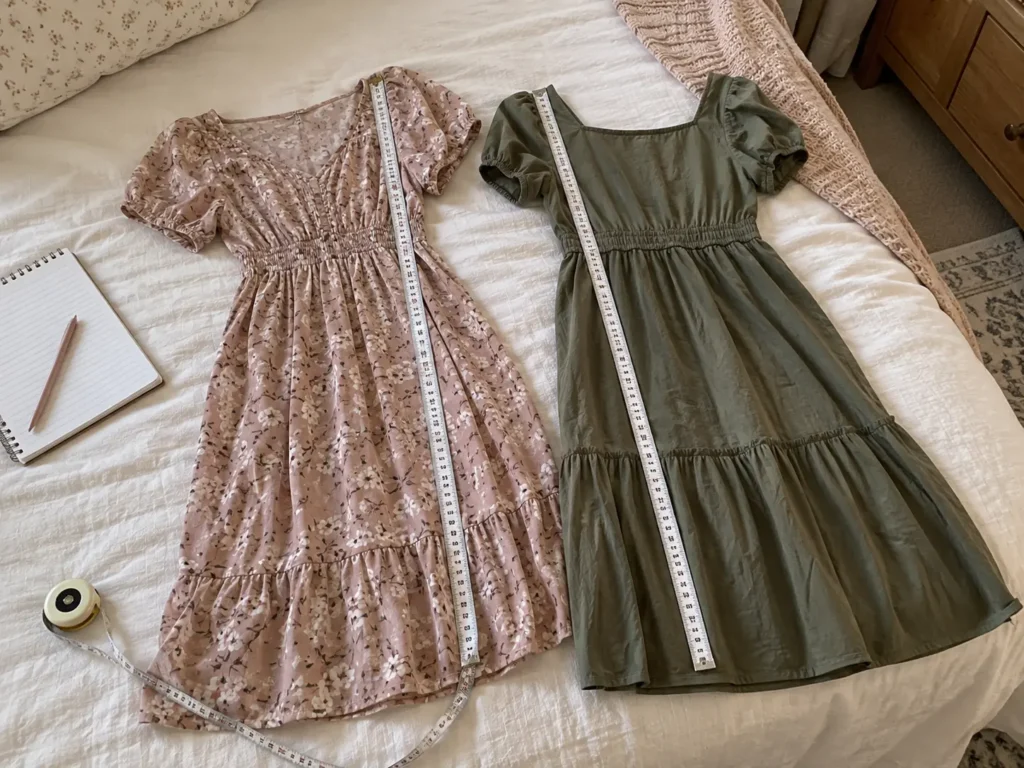
And then there’s the fabric. A soft, stretchy dress and a stiff woven one can measure almost the same but feel completely different when you put them on. If it’s that easy, flowy look you love, I’d check the material and lining, then look for photos of someone standing normally rather than posing with the skirt.
You may still love everything about the dress. I’d just want to know a little more about the fabric before ordering it for that particular look.
Will that bag hold what you carry?
A shoulder bag can look perfect on a model. Then you remember your phone, wallet, keys, glasses case and somehow all the other little things that end up in your bag.
Say it’s listed as 10 by 7 by 3 inches. You can draw the front outline on paper and hold it against your side to get an idea of the size. If the strap drop is listed, check that too, because a bag sitting at your waist can look quite different from one sitting closer to your hip.
I’d also put the things I normally carry together on the table. It won’t tell you exactly how much fits inside, but it can help you spot a bag that’s obviously too small. And remember, thick lining, inner pockets and a narrow zip opening can leave you with less room than you expected.
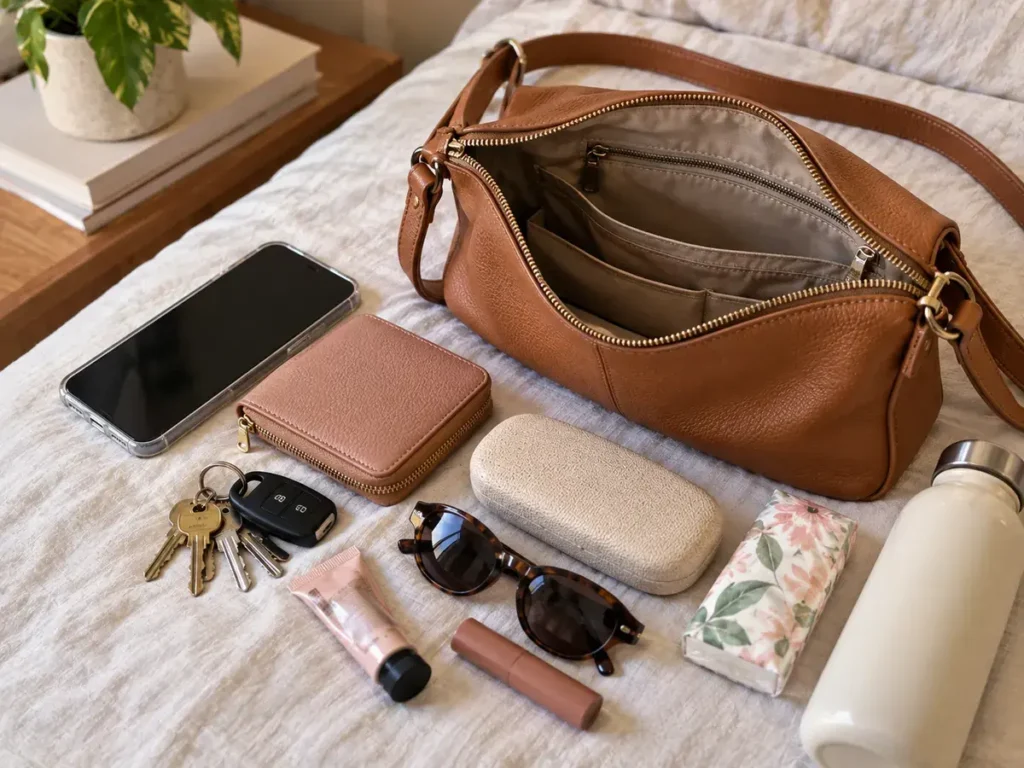
Personally, I’d rather see a customer photo with the bag open than another beautiful outfit shot. Sometimes you don’t think about the opening at all until you’re trying to get your phone out with one hand.
Have a look at everything around the product
Sometimes the styling is half the reason you love the photo. That bedding looks gorgeous with cushions piled up and a throw across the end. But are those cushions included? Is it a duvet cover and pillowcases, or something else? The word “set” on its own doesn’t really tell you.
And before you get too attached to a particular colour, check which version you’ve actually selected. Some listings keep showing the same main photo even after you’ve clicked on another option.
Colour is one of those things I wouldn’t judge from a single photo anyway. A cream lampshade photographed in bright light might look more yellow under the warm bulbs in your bedroom. Customer pictures are helpful, although they can look different depending on the lighting, too.
You might even be looking at a product in an edited or digitally created room. I wouldn’t spend ages trying to guess how the image was made. I’d be more interested in whether the listing actually tells me what the product is made from, its size and what’s included.
Look in the reviews for the detail you’re worried about
I wouldn’t start by reading every review. If the dress looks a bit thin, I’d search for words like “lined” or “sheer.” If you’re worried about the bag opening, try “zipper” or “phone.” And if that lamp shade looks yellow in some photos, see whether anyone mentions the colour.
A review that just says “Love it!” is lovely, but it doesn’t tell you much when you have a specific question. The same goes for someone calling a bag tiny without explaining what they were expecting to fit inside.
I’d pay more attention to people who explain how they’re using the product, especially if several of them bring up the same problem. And if there’s a customer photo showing exactly what you’re unsure about, that’s usually more helpful than another picture where everything looks beautiful.
And if you’re still not completely sure?
With some things, you probably won’t be. You can’t feel a fabric through your screen, and even ten different photos might not tell you the exact shade of beige.
I’d be more careful with a dress I need for an event next weekend than one I’m buying just to wear casually. The same goes for a large mirror that’s expensive to return. That’s the sort of purchase where I’d want to be pretty sure about the finish before ordering. For something smaller that’s easy to send back, a little uncertainty might not bother you as much. It’s worth checking the return terms for the actual item, though.
And if you’re still thinking about that lamp, leave the paper marking its base on your bedside table for an evening. Put your phone down, reach for your water, pick up your book. See whether you keep having to move things around. It’s much nicer to find that out while the lamp is still sitting in your online cart.